Guide
How to Convert Decimal to Fraction — Step-by-Step Guide
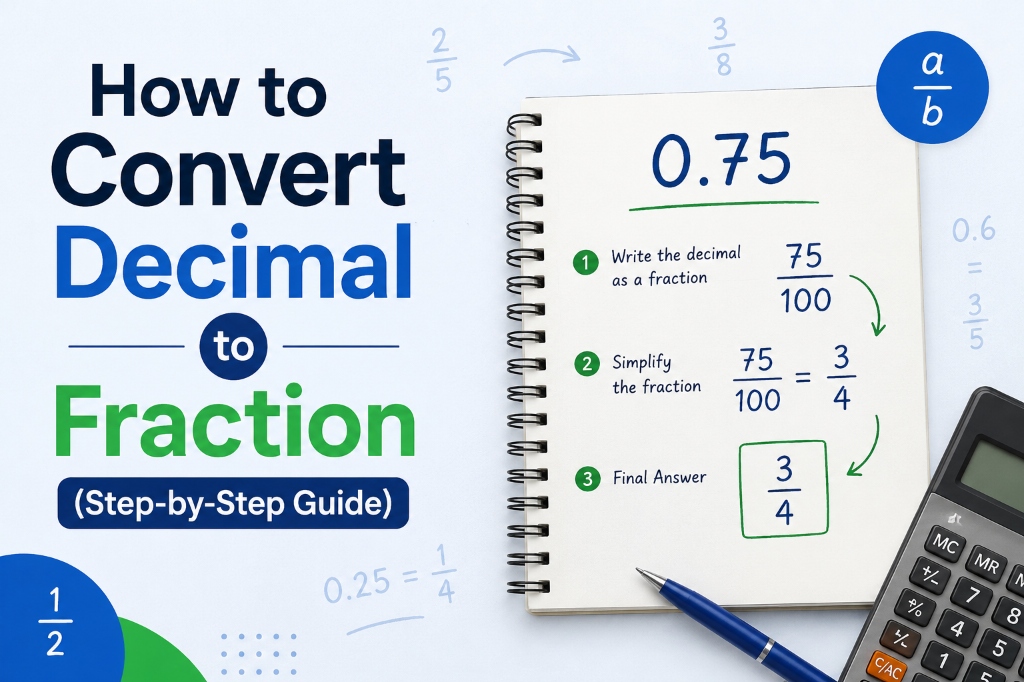
Converting a decimal to a fraction is one of the most practical math skills you can learn. Whether you are finishing a homework problem, measuring materials for a project, or double-checking a recipe, knowing how to rewrite a decimal as an exact fraction gives you a clearer picture of the number you are working with.
This guide walks through the complete process for terminating decimals — decimals that end after a fixed number of digits, such as 0.75 or 1.25. You will learn how decimal place value determines the denominator, how to form the initial fraction, and how to simplify it to its lowest terms using the greatest common divisor (GCD). By the end, you will be able to convert any terminating decimal to a fraction by hand, verify the result, and understand exactly why the method works.
Quick Answer
To convert a terminating decimal to a fraction:
- Count the number of digits after the decimal point.
- Write those digits as the numerator (top number).
- Set the denominator (bottom number) to 10, 100, 1,000, or the appropriate power of 10.
- Find the greatest common divisor (GCD) of the numerator and denominator.
- Divide both by the GCD to simplify.
- Verify by dividing the final numerator by the final denominator — the result should equal the original decimal.
Example: 0.75 → 75/100 → GCD is 25 → 3/4
What Is a Decimal?
A decimal is a way of writing a number that includes a fractional part. It uses a decimal point — the dot between the whole-number portion and the fractional digits — to separate the two.
The position of each digit after the decimal point represents a specific place value:
- The first digit after the decimal point is in the tenths place.
- The second digit is in the hundredths place.
- The third digit is in the thousandths place.
For example, in the decimal 0.125:
- 1 is in the tenths place (1/10)
- 2 is in the hundredths place (2/100)
- 5 is in the thousandths place (5/1000)
Together, 0.125 means 125 thousandths, or 125/1000. Understanding place value is the key to choosing the correct denominator when you convert a decimal into a fraction.
What Is a Fraction?
A fraction represents a part of a whole. It is written as two numbers separated by a horizontal bar (the fraction bar):
- The top number is the numerator. It tells you how many parts you have.
- The bottom number is the denominator. It tells you how many equal parts make up one whole.
In the fraction 3/4, the numerator is 3 and the denominator is 4. This means three out of four equal parts.
Fractions and decimals are two different ways of expressing the same type of number. Converting between them lets you choose whichever form is more convenient for the task at hand.
The Core Rule
For any terminating decimal, the conversion rule is straightforward:
Write the digits after the decimal point as the numerator. Set the denominator to 10ⁿ, where n is the number of digits after the decimal point. Then simplify.
| Decimal places | Denominator |
|---|---|
| 1 | 10 |
| 2 | 100 |
| 3 | 1,000 |
| 4 | 10,000 |
This works because each decimal place represents a successive power of ten. One digit after the decimal point means tenths (10¹), two digits means hundredths (10²), and so on.
Step-by-Step Method
Step 1 — Count the decimal places
Look at the decimal and count how many digits appear after the decimal point. This number determines your denominator.
- 0.7 → 1 decimal place → denominator is 10
- 0.35 → 2 decimal places → denominator is 100
- 0.625 → 3 decimal places → denominator is 1,000
Step 2 — Remove the decimal point and form the fraction
Take all the digits (ignoring the decimal point) and write them as the numerator. Place the appropriate power of 10 underneath as the denominator.
0.75 → numerator is 75, denominator is 100 → 75/100
Step 3 — Find the GCD
The greatest common divisor (GCD) is the largest number that divides evenly into both the numerator and the denominator. Finding the GCD is how you simplify a fraction to its lowest terms.
For 75 and 100:
- Factors of 75: 1, 3, 5, 15, 25, 75
- Factors of 100: 1, 2, 4, 5, 10, 20, 25, 50, 100
- The largest number in both lists is 25
So GCD(75, 100) = 25.
Step 4 — Divide both by the GCD
Divide the numerator and the denominator by the GCD:
- 75 ÷ 25 = 3
- 100 ÷ 25 = 4
The simplified fraction is 3/4.
Step 5 — Check the answer
Divide the final numerator by the final denominator:
3 ÷ 4 = 0.75 ✓
The result matches the original decimal, confirming the conversion is exact.
Worked Examples
Example 1 — Convert 0.5
0.5 → 1 decimal place → 5/10
GCD(5, 10) = 5
5 ÷ 5 = 1 · 10 ÷ 5 = 2
0.5 = 1/2
Example 2 — Convert 0.25
0.25 → 2 decimal places → 25/100
GCD(25, 100) = 25
25 ÷ 25 = 1 · 100 ÷ 25 = 4
0.25 = 1/4
Example 3 — Convert 0.75
0.75 → 2 decimal places → 75/100
GCD(25, 100) = 25
75 ÷ 25 = 3 · 100 ÷ 25 = 4
0.75 = 3/4
Example 4 — Convert 0.125
0.125 → 3 decimal places → 125/1000
GCD(125, 1000) = 125
125 ÷ 125 = 1 · 1000 ÷ 125 = 8
0.125 = 1/8
Example 5 — Convert 0.6
0.6 → 1 decimal place → 6/10
GCD(6, 10) = 2
6 ÷ 2 = 3 · 10 ÷ 2 = 5
0.6 = 3/5
Example 6 — Convert 0.45
0.45 → 2 decimal places → 45/100
GCD(45, 100) = 5
45 ÷ 5 = 9 · 100 ÷ 5 = 20
0.45 = 9/20
Example 7 — Convert 1.25
1.25 → 2 decimal places → 125/100
GCD(125, 100) = 25
125 ÷ 25 = 5 · 100 ÷ 25 = 4
1.25 = 5/4 (improper fraction) = 1 1/4 (mixed number)
Example 8 — Convert 2.5
2.5 → 1 decimal place → 25/10
GCD(25, 10) = 5
25 ÷ 5 = 5 · 10 ÷ 5 = 2
2.5 = 5/2 (improper fraction) = 2 1/2 (mixed number)
Decimals Greater Than 1
The same procedure works for any decimal greater than 1. The only difference is that the result is usually an improper fraction — a fraction where the numerator is larger than the denominator.
Example: 2.75
2.75 → 2 decimal places → 275/100
GCD(275, 100) = 25
275 ÷ 25 = 11 · 100 ÷ 25 = 4
2.75 = 11/4
To rewrite as a mixed number, divide 11 by 4:
11 ÷ 4 = 2 remainder 3
11/4 = 2 3/4
Terminating Decimals
A terminating decimal is a decimal that ends after a finite number of digits. Examples include 0.5, 0.25, 0.125, and 1.75.
Every terminating decimal can be converted to an exact fraction using the method above. Because the decimal ends, you can always determine the precise denominator (a power of 10) and simplify. The resulting fraction represents the original decimal exactly — it is not an approximation.
Repeating Decimals
A repeating decimal is a decimal in which one or more digits repeat infinitely. Examples:
- 0.333... (the digit 3 repeats)
- 0.666... (the digit 6 repeats)
- 0.121212... (the pattern 12 repeats)
Repeating decimals also represent exact fractions — for instance, 0.333... = 1/3 and 0.666... = 2/3 — but the "write it over a power of 10" approach does not work directly because the decimal never terminates. Converting repeating decimals requires a different algebraic technique.
Common Mistakes
- Using the wrong denominator. If a decimal has two digits after the decimal point, the denominator must be 100, not 10. Always count the decimal places carefully.
- Forgetting to count decimal places. Skipping straight to "write the number over 10" works only for one-digit decimals like 0.7. For 0.75 or 0.625, you need 100 or 1,000.
- Not simplifying. Writing 75/100 is technically correct, but the fraction is not in simplest form. Always find the GCD and reduce.
- Dividing only the numerator or only the denominator. When you simplify, you must divide both the numerator and the denominator by the same number.
- Treating a repeating decimal as terminating. Writing 0.333 as 333/1000 gives 333/1000 — not 1/3. The repeating decimal 0.333... requires the algebraic method.
- Confusing place value. The first digit after the decimal point represents tenths, not ones.
- Forgetting about improper fractions. A decimal like 3.5 produces 35/10 = 7/2 (or 3 1/2). Do not discard the whole-number part.
- Giving an approximation when an exact fraction exists. Terminating decimals always convert to exact fractions. There is no need to round or approximate.
Decimal to Fraction Cheat Sheet
| Decimal | Initial Fraction | Simplified Fraction |
|---|---|---|
| 0.1 | 1/10 | 1/10 |
| 0.2 | 2/10 | 1/5 |
| 0.25 | 25/100 | 1/4 |
| 0.3 | 3/10 | 3/10 |
| 0.4 | 4/10 | 2/5 |
| 0.5 | 5/10 | 1/2 |
| 0.6 | 6/10 | 3/5 |
| 0.625 | 625/1000 | 5/8 |
| 0.75 | 75/100 | 3/4 |
| 0.8 | 8/10 | 4/5 |
| 0.125 | 125/1000 | 1/8 |
| 0.375 | 375/1000 | 3/8 |
| 0.45 | 45/100 | 9/20 |
| 1.25 | 125/100 | 5/4 |
| 1.5 | 15/10 | 3/2 |
| 2.5 | 25/10 | 5/2 |
Manual Method vs. Calculator
A calculator can verify your answer quickly — just divide the numerator by the denominator and check that the result matches the original decimal. However, performing the conversion by hand teaches you why the process works: you learn how place value determines the denominator, how the GCD simplifies the fraction, and how fractions and decimals relate within the number system.
How to Check Your Answer
- Divide the numerator by the denominator. The quotient should equal the original decimal. For example, 3 ÷ 4 = 0.75.
- Confirm the fraction is fully reduced. The numerator and denominator should share no common factor greater than 1.
- Re-derive the fraction. Start from the original decimal a second time and repeat the steps.
FAQ
How do I convert a decimal to a fraction?
Count the digits after the decimal point, write those digits as the numerator, set the denominator to the matching power of 10 (10 for one digit, 100 for two, 1,000 for three), and then simplify the fraction by dividing the numerator and denominator by their greatest common divisor.
What is the easiest way to convert a decimal to a fraction?
The fastest manual approach is the place-value method: count decimal places, form the fraction, and simplify. For quick reference, memorize common conversions like 0.5 = 1/2, 0.25 = 1/4, and 0.75 = 3/4.
How do you convert 0.75 to a fraction?
0.75 has two decimal places, so write 75/100. The GCD of 75 and 100 is 25. Divide both by 25 to get 3/4. Check: 3 ÷ 4 = 0.75 ✓
How do you convert 0.25 to a fraction?
0.25 has two decimal places → 25/100. GCD(25, 100) = 25. Divide both by 25 → 1/4. Check: 1 ÷ 4 = 0.25 ✓
How do you convert 0.5 to a fraction?
0.5 has one decimal place → 5/10. GCD(5, 10) = 5. Divide both by 5 → 1/2. Check: 1 ÷ 2 = 0.5 ✓
How do you convert a decimal greater than 1 into a fraction?
Use exactly the same method. The result will be an improper fraction (numerator larger than denominator), which you can optionally rewrite as a mixed number. For example, 1.25 → 125/100 → 5/4 → 1 1/4.
How do you simplify a decimal fraction?
Find the GCD of the numerator and denominator, then divide both by that number. For instance, 45/100: GCD is 5, so 45 ÷ 5 = 9 and 100 ÷ 5 = 20. The simplified fraction is 9/20.
Why is the denominator 100 for two decimal places?
Each decimal place represents a power of 10. The first place is tenths (10¹ = 10), the second is hundredths (10² = 100), the third is thousandths (10³ = 1,000), and so on. Two decimal places means hundredths, so the denominator is 100.
Can every decimal be converted to a fraction?
Every terminating decimal and every repeating decimal can be written as an exact fraction. The place-value method works directly for terminating decimals. Repeating decimals require an algebraic approach but also produce exact fractions.
Can repeating decimals be converted to fractions?
Yes. Repeating decimals like 0.333... and 0.666... represent exact fractions (1/3 and 2/3). However, the simple "write it over a power of 10" method does not apply to repeating decimals.
Do I need a calculator to convert a decimal to a fraction?
No. The manual method requires only basic arithmetic: counting decimal places, writing a fraction, finding the GCD, and dividing.